
"I feel deflated."
Those were the words of a distraught mother after I shared some pretty basic substance use treatment family educational material with her.
"We got none of that."
After repeated incidents of substance use related trouble, she had received a recommendation to place her 17-year-old son in a wilderness therapy program. He completed the eight-week program, returned home, and promptly relapsed. When she called me, he had run away from home, and in her words, was using "some pretty scary drugs."
In another case, the parents of a 16-year-old girl contacted towards the end their daughter's time in an eight-week dual diagnosis PHP program. Substance use had definitely been one of the precipitating factors leading to her admission. When I asked them what the program was doing to treat her substance use disorder, their response was, "They're teaching her coping mechanisms for when she has cravings." When I asked if the clinical team had ever discussed her treatment plan for her substance use disorder, they said: "No."
The first day back to school after completing the PHP program, the girl was arrested for using cannabis at school, and was expelled.
One more...
The mother of another 17-year-old boy called after he had completed a 90-day dual-diagnosis residential treatment program. He went back to smoking marijuana shortly after he completed the program. As I spoke with the mother about the importance of addressing substance use responsibly when it’s part of a “dual” diagnosis, her response was:
“Thank you! That’s what I’ve been feeling, but I haven’t been sure what to say about it.”
When I suggested that a “sort-of” addressed issue becomes an elephant in the room that ultimately causes problems with interpersonal relationships and family dynamics, she said:
“Exactly! That’s a really good way to put it.”
Things went off the rails very quickly and he ended up back in another 90-day residential program, this time with an emphasis on making sure the substance use disorder was addressed appropriately.
I might add that in this case, the parents paid for both treatment programs out of pocket, to the tune of over $150,000.
The common thread in all of these cases is clear:
Substance use was identified as an issue going into treatment, and simply put, was not addressed responsibly—by the providers who were supposed to be treating it.
And that's a problem.
The Problem With "Problem"
Effective prevention and treatment efforts must begin with understanding what the problem is that being addressed. Over the past decade, I have become increasingly aware of how misinformed perceptions of what it means to have a "problem" lead to the kind of heartache families like the ones described above suffer when substance use falls through the cracks.
The case that really opened my eyes was when a mother told me her 18-year-old son had been seeing an outpatient therapist for over a year. She told his psychiatrist she didn't feel any progress was being made—partly because the client continued to use marijuana throughout that time—and the psychiatrist referred her to me.
The mother informed me that this therapist had done a substance use assessment and told her that her son had a mild substance use disorder. What she said next should stop us all in our tracks:
"But he said it was only mild, so we didn't need to do anything other than our weekly sessions."
In my first session with the client, I took the time to explain to this client what it means to have a substance use disorder diagnosis, how it is diagnosed, and the implications for treatment.
In one session this client went from resistant to even addressing his substance use to being motivated for recovery—by simply providing some responsible education about what it means to have a "problem."
Most people have an idea of there being a line you cross over. Once you cross over that line, you have a "problem," and there's no going back. That's also where they start thinking about being addicted, and "once an addict, always an addict."
The problem with that thinking is that it's outdated.
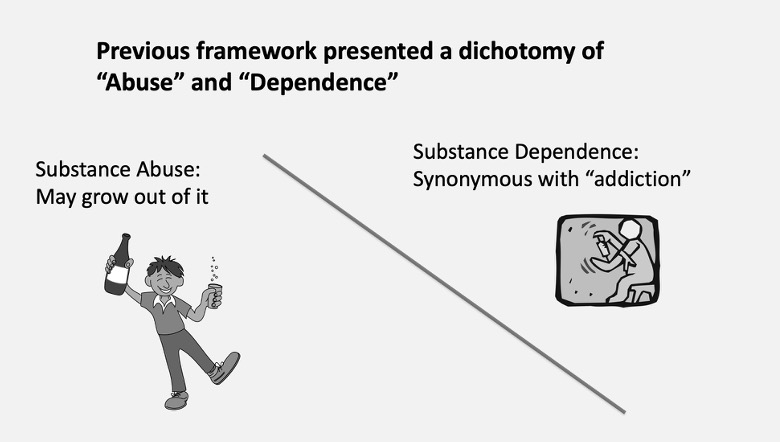
I believe the therapist who told the mother they didn't need to do anything differently because his diagnosis was "mild" was demonstrating a common misperception I see among many mental health professionals and treatment providers today. As harsh as it may sound, this often becomes a case of "knowing enough to be dangerous."
The original diagnostic framework for Substance Use Disorder (prior to DSM-5) supported this dichotomy of crossing over a line. It differentiated between Substance Abuse and Substance Dependence as separate diagnoses. However, that all changed with DSM-5, when they collapsed the two separate diagnoses into one Diagnosis of Substance Use Disorder. With categories of mild, moderate, and severe.
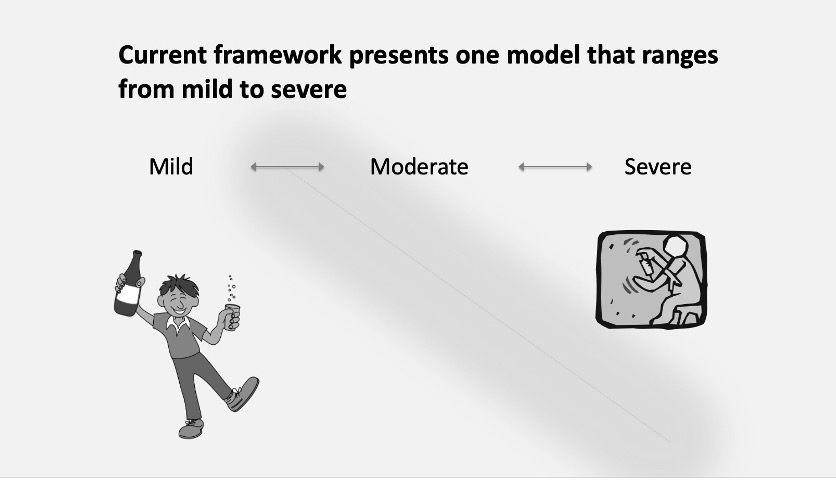
I believe this therapist had in his both the old idea of
a. crossing over a line, and
b. the current framework of mild, moderate, and severe.
The mistake comes from conflating those ideas. Instead of understanding “mild” as part of a treatable substance use disorder, the therapist saw it as “not having crossed the line” and, in effect, dismissed it as “not a problem.”
The common denominator in every one of these cases wasn't the clients. It was the failure to properly identify and treat a substance use disorder.
It's no coincidence that all of these clients are young. This is an inherent problem with early stage substance use diagnosis and treatment: Most young substance users haven't been using long enough to have a severe diagnosis, and that's where the water gets murky as far as appropriate treatment planning. As these cases point out, the responsibility falls on the providers to be properly trained in assessment, diagnosis, and treatment planning, especially in dual diagnosis cases.
Changing The Conversation
When I wrote Rehab Works! in 2014, my goal was to help families better understand substance use treatment. In the years since, I've become increasingly convinced that we also need to improve how professionals think about early-stage substance use disorders and treatment planning.
These cases were among the experiences that convinced me it was time to publish a thoroughly revised edition of Rehab Works!. They reinforced something I've come to believe strongly over the past decade: prevention, intervention, and treatment efforts become more effective when we improve how we identify, understand, and talk about substance use disorders.
One of the defining features of the revised edition is a series of "2026 Hindsight" sections, where I revisit the original text and ask, "What have I learned over the past decade?" This case became the very first of those reflections—and ultimately one of the most important. In fact, the title of that Hindsight section, He's Just Going To Tell Me I'm A Bad Person, captures what may be the most important lesson I learned over the past decade:
Stigma itself can become one of the greatest barriers to treatment.
But that section is just one example. Throughout the revised edition, I revisit familiar concepts through the lens of what we've learned over the past decade—challenging long-held assumptions about substance use, treatment, and family recovery while showing how seemingly small shifts in understanding can reduce resistance, increase motivation, and ultimately improve treatment outcomes.
You can read that complete "2026 Hindsight" section—and many more like it—when the revised edition of Rehab Works! is released later this month.
If we're serious about improving treatment outcomes, we have to begin by changing the conversation about what the problem even is.
If you'd like to follow this conversation—and be notified when the revised edition of Rehab Works! is released—join my mailing list below.
FREE eBOOK
Sobriety Doesn't Have To Suck!
A Guide To Finding Excitement, Renewal, And Spiritual Fulfillment In Recovery
Stay connected with news and updates!
Join our mailing list to receive news, resources, and updates.
Don't worry, your information will not be shared.
(We won't send spam. Unsubscribe at anytime.)
