
Facing a substance use issue with a loved one is one of the most challenging ordeals a family may ever have to face. Whether it's your child, a spouse, a sibling, or even a parent.
It's exhausting.
It's terrifying.
It's isolating.
One thing that happens over time is that you learn to adapt—in not a good way. Despite all the ways you can see the need for change, there's always a little voice in the back of your mind telling you:
"Don't rock the boat."
One of the most impactful things I see happen for families when they begin their own work to recover is the recognition that this unconscious drive not to rock the boat is ultimately tied to their own sense of security. And from the brain's perspective, security is a pleasurable event. While this may not feel "pleasant" at the time, the brain stores the memory of that pleasurable event, and not unlike addiction, it begins to look for that good feeling when facing times that threaten that feeling of security.
Like when the phone rings.
Or they don't show up.
Or you catch them in a lie.
The response process is not unlike the addict's response to something that reminds them of the using—the pleasurable event of changing how they feel. They become "triggered." The brain starts telling them they want that feeling, overriding the logical part of the brain that would say "not a good idea right now."
For the family, this goes to the heart of what codependency is all about: the desire for a good feeling—which in this case would be some form of emotional, relational, or physical security in response to a triggering event that threatens that security.
What’s often overlooked is that the same process we use to help someone recover from addiction also applies—almost exactly—to the family members who love them.
RECOVERY: FREEDOM FROM ESCAPE
In my work with substance use clients over the years, I have always believed that the most effective approach to recovery begins with lighting a spark. In other words, helping a person become inspired—fired up—about beginning a journey that leads to personal transformation.
I write about this in my eBook Sobriety Doesn’t Have to Suck!:
“When a person becomes excited about moving toward something, the urge to escape loses its power.”
Addiction, at its core, is about changing how one feels. When someone doesn’t like how they feel, it’s understandable that they would look for relief.
But the converse is also true.
When a person begins to feel good—when they experience purpose, meaning, or a sense of direction—the desire to escape begins to fade. Inspiration itself becomes motivating. A taste of something better creates momentum.
This is why recovery is not only about stopping a behavior; effective treatment also includes helping the individual become excited about moving toward something that feels meaningful.
FAMILY RECOVERY
One of the most gratifying aspects of working with families is being able to help individual family members experience essentially the same relief their loved ones experience in recovery: the freedom from escape.
Again, if we look at the family's tendency to adapt to the dynamics of an addictive family system, we can draw a through-line from:
a. the addict's desire to change how they feel, to
b. the family member's desire to change how they feel.
Same dynamic, different coping mechanism.
It follows that learning how to feel good from within—rather than relying on external factors to dictate how one feels—would be the key to family recovery, much the same as recovery from a substance use disorder.
I have a presentation I call the Family Recovery Framework. It consists of four quadrants: Controlling, Defeated, Chaos, and Peace Of Mind. It effectively provides a roadmap for helping families identify where they are and how to get to the very attractive sounding Peace Of Mind quadrant.
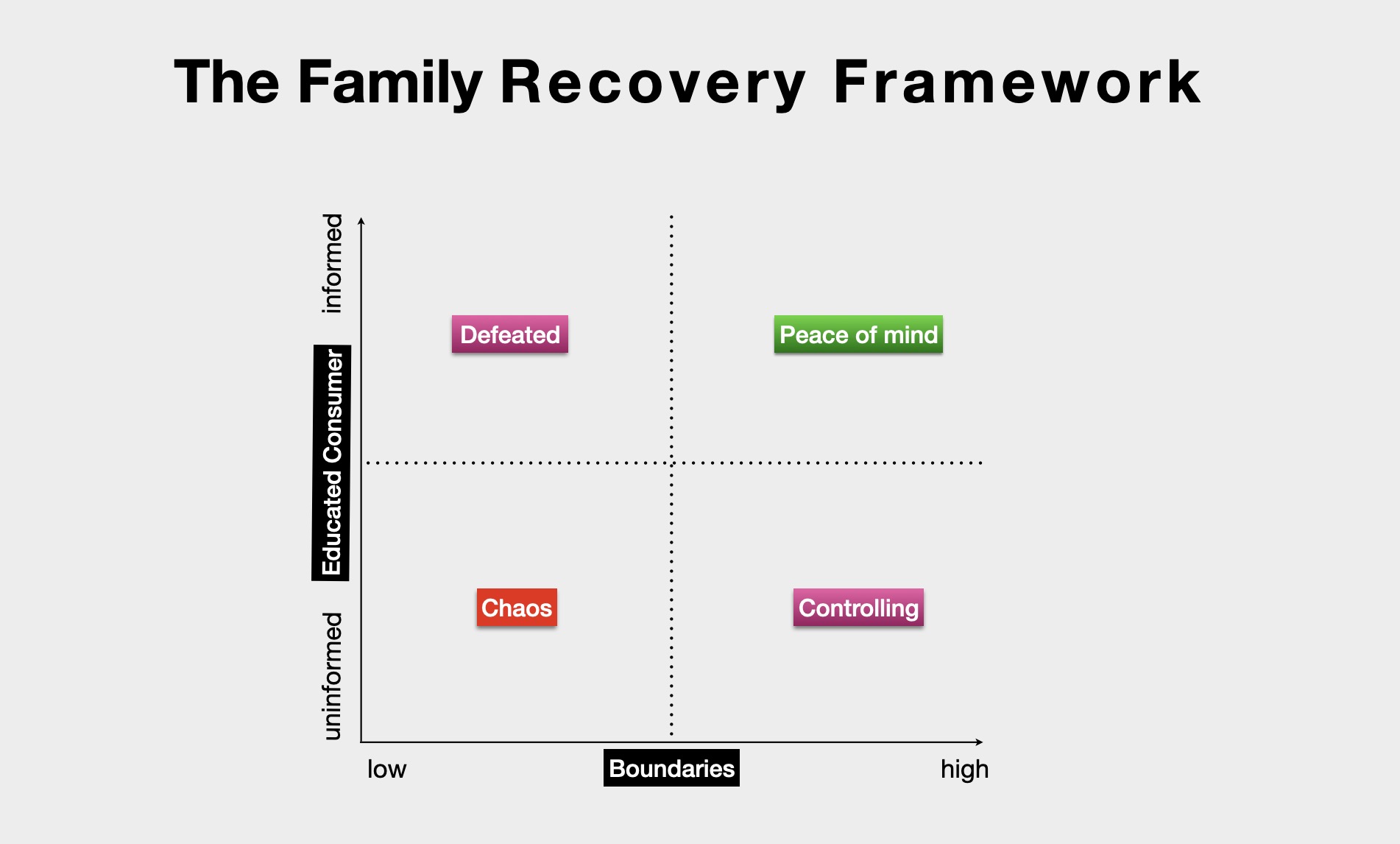
My experience is that simply showing families this framework—and briefly discussing what “peace of mind” actually means—can be inspiring in and of itself.
For example:
Being in a place where you are constantly accused of being controlling: probably doesn't feel good.
Being in a place where you feel defeated ("nothing's ever going to change"): probably doesn't feel good.
Being in the chaos of living with an unaddressed substance use issue: probably doesn't feel good.
However, when they see that there is hope for getting to a place that feels good, they become motivated to begin moving in that direction. Progress towards the peace of mind quadrant results in beginning to feel better. And when they feel better, the urge to escape through old behaviors which kept them stuck in those less desirable quadrants loses power.
As I mentioned above, it’s extremely gratifying to watch family members move from “I’m here because I want my loved one fixed,” to finding healing, happiness, and fulfillment through their own recovery.
That shift often begins simply by realizing that another way of feeling may actually be possible.
ADDITIONAL RESOURCES
Family Recovery Framework Video
If the framework for moving from chaos to peace of mind resonates with you, I’ve put together a short video that explores it in more depth.
It’s an overview of how this framework can help families better understand where they are, how to provide more effective support for their loved one, and how to begin moving forward in their own recovery as well.
→ Video: Framework For Family Recovery
FREE eBOOK
Sobriety Doesn't Have To Suck!
A Guide To Finding Excitement, Renewal, And Spiritual Fulfillment In Recovery
Stay connected with news and updates!
Join our mailing list to receive news, resources, and updates.
Don't worry, your information will not be shared.
(We won't send spam. Unsubscribe at anytime.)
