
A Special Message for Outreach & Clinical Providers
Family Support For Improving Treatment Outcomes
If you’re dealing with families who need more support than your team can realistically provide, I offer a turnkey family education and coaching program designed specifically for that gap.
In this context, the RehabWorks Family Coaching Program becomes a tool for providers—not simply a traditional family coaching option, but a comprehensive family education and support program designed to reduce the time and energy your team spends managing family dynamics.
This support is especially critical during the first days and weeks of treatment—or even before a client enters care.
- reinforce treatment goals with families
- reduce staff time spent managing family dynamics
- improve family support follow-through during treatment and discharge

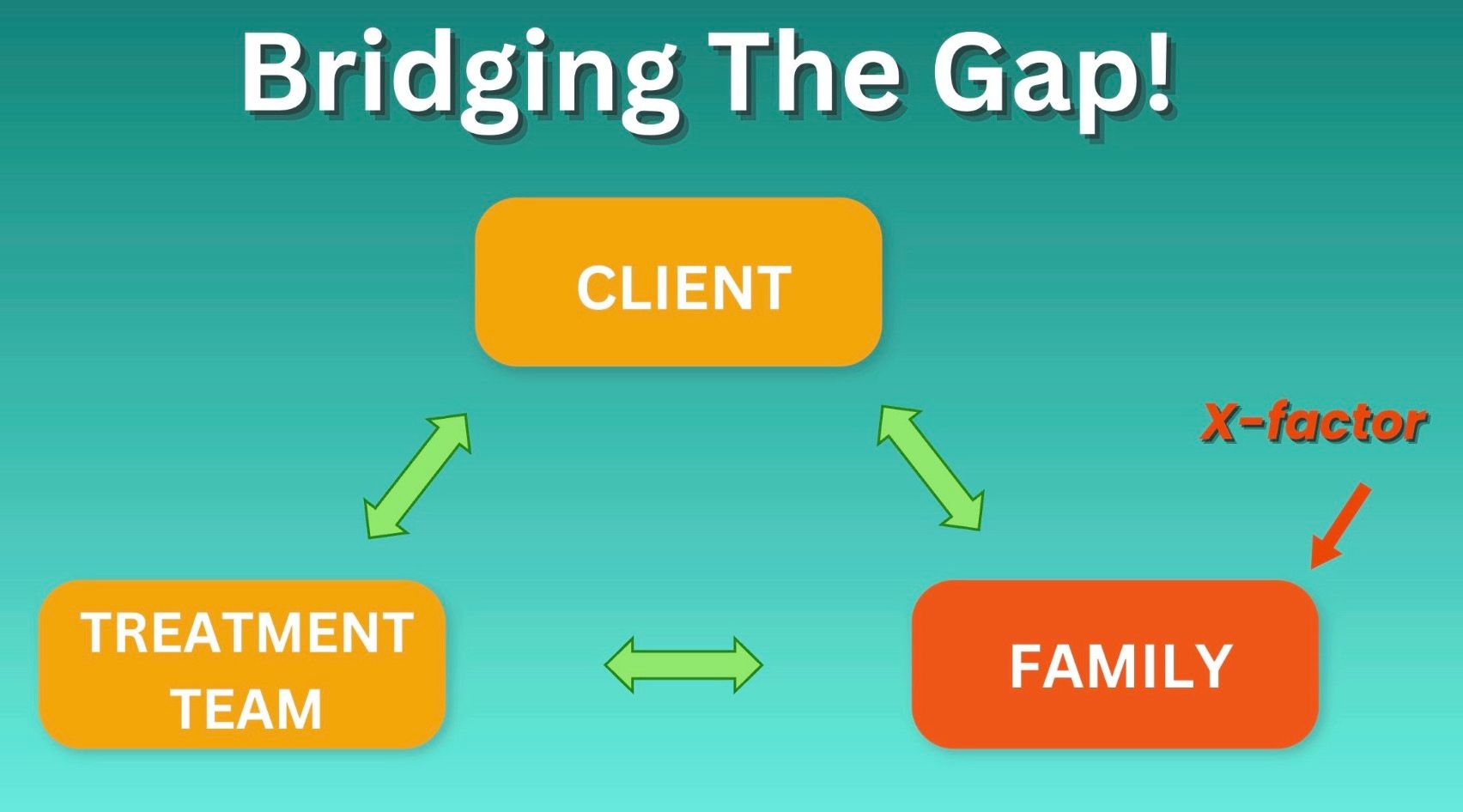
Family: The X-Factor in Substance Use Intervention and Treatment
Every provider knows the truth — families can be your greatest asset… or your biggest obstacle. The difference almost always comes down to the support they receive.
This is the gap I help close through my RehabWorks Family Coaching Program.
Here’s what your families learn while working with me — in a timely fashion that supports your clinical work:
-
Understanding the need for treatment
-
Understanding how long treatment takes
- Knowing how to respond to resistance and set clear and informed boundaries
-
Understanding their role in treatment support — and becoming allies with the treatment team
-
Understanding — and reducing resistance — to establishing their own family recovery

Need to refer a family right now?
Jump To Referral Steps ↓
More Than Just A Family Coach
When families work with me, they don’t just get a coach — they get access to the only complete family-support program of its kind. This includes exclusive online education, individual coaching sessions, group calls, and hands-on case management.
What makes this different is that families receive vital information and guidance designed specifically to strengthen and support your clinical process with them—whether you’re:
- at the intervention stage and helping a family decide how to take action, or
- supporting them in becoming proactive, informed allies of the treatment team once treatment has begun.
With more than three decades of clinical experience, I’ve built and run my own treatment program, authored RehabWorks! A Family’s Guide to Substance Use Treatment, and created an entire family-support program dedicated to helping families navigate substance use treatment with a loved one.
Through the RehabWorks Family Coaching Program, families receive something unique: a complete education system — plus a seasoned clinician walking beside them every step of the way.
My work with RehabWorks now supports families in treatment programs across the country.

Supporting Families at Every Stage of Treatment
Families often need guidance at the most critical moments — before treatment begins, during the chaos of early recovery, and as discharge approaches. The RehabWorks Family Coaching Program gives them structured support at each step.
RehabWorks Family Coaching Program
Powerful tools for every stage in the treatment process

Intervention
Help families understand the need for treatment and become willing to take action in getting their loved one help.

Treatment Support
Specialized support for helping families become proactive, informed partners in their loved one's treatment process

Discharge Planning
Ensure compliance with continuing care plan and identify potential problems PRIOR to discharge
CORE PREMISE OF REHABWORKS
"Treatment success is an interactive process in which the family has much more to do with the outcome than is generally realized."
Jim Savage, Rehab Works! A Family’s Guide To Substance Use Treatment
When families are informed and appropriately involved, outcomes improve.
That’s the foundation of RehabWorks — and the driving force behind the RehabWorks Family Coaching Program, giving outreach teams and treatment providers a reliable framework — and a powerful ally — to close the gap between family engagement and clinical support.

A Clear Framework For Success
RehabWorks gives families a structured, ready-to-deliver system for taking a proactive role through every phase of treatment — equipping them with the tools they need to become effective allies in the clinical process.
With RehabWorks, families:
-
Learn what clients learn in treatment — gaining real understanding of substance use disorder and what recovery truly requires.
-
Gain tools for setting informed boundaries that align with treatment goals and strengthen collaboration with the care team.
-
Learn how to avoid common pitfalls that derail progress and undermine recovery

Education + Boundaries + Measurement = Family Engagement That Drives Better Outcomes.
Comprehensive Family Education
A 3-module curriculum that gives families facing a substance use issue what they need — when they need it.

A Closer Look At The Modules
MODULE I: WHAT'S THE PROBLEM?
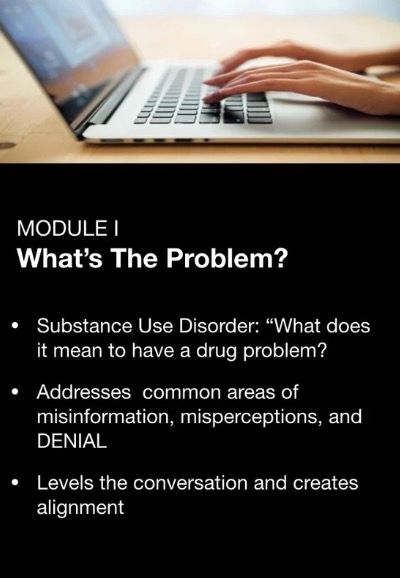
RehabWorks begins by giving families a clear, accessible overview of Substance Use Disorder — what it means, how it’s diagnosed, and what that implies for recovery.
Module I: Clinical Impact and Support
Module I supports treatment teams by providing families with a solid educational foundation for understanding of Substance Use Disorder. When families receive this education early, it reduces confusion, resistance, and misinformation that can interfere with the clinical process.
This module helps treatment providers by:
-
Establishing a unified understanding of Substance Use Disorder so families are aligned with the treatment team from Day 1.
-
Reducing denial and misinformation that often complicate treatment planning and clinical engagement.
-
Improving family participation and helping them become proactive supporters of the treatment plan.
-
Preventing common power struggles, allowing clinicians to stay focused on clinical goals instead of battling misconceptions such as:
-
“I’m not as bad as everybody else here.”
-
“I’ll quit Xanax and cocaine, but I can still smoke pot.”
-
“I don’t see why I can’t have a glass of wine once in a while.”
-
“It wouldn’t be a problem if they didn’t think it was.”
-

A Closer Look At The Modules
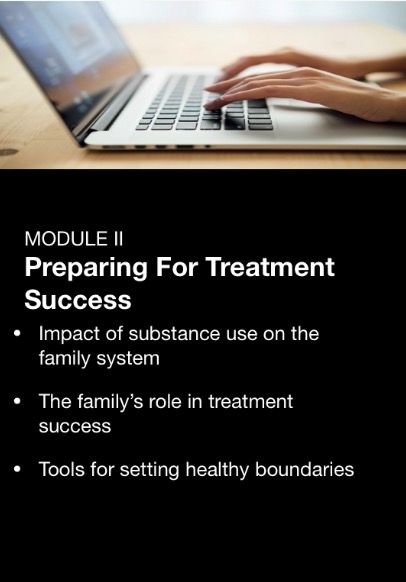
MODULE II: PREPARING FOR TREATMENT SUCCESS
Module II explores the family’s role in supporting treatment through:
- Setting boundaries
- Increasing client accountability
- Establishing family recovery
Module II: Clinical Impact and Support
Module II shifts to examining the family’s role in treatment support. When families understand their role and learn how to step out of codependent dynamics, they create the conditions for accountability, alignment, and treatment progress.
This module helps treatment providers by:
-
Teaching families that “Treatment success is an interactive process in which the family has much more to do with the outcome than is generally realized,” helping create buy-in for active participation.
-
Explaining the impact of substance use on the family system and giving families tools to step out of codependent or enabling patterns.
-
Providing tools for setting boundaries, eliminating enabling, and supporting treatment accountability for the client.
-
Shifting families from a client-focused mindset to establishing family recovery as an essential part of long-term outcomes.
A Closer Look At The Modules
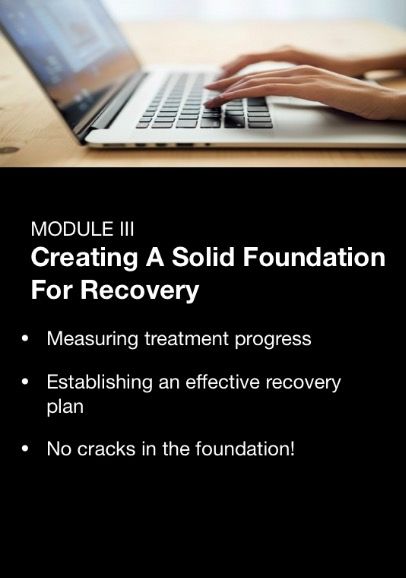
MODULE III: CREATING A SOLID FOUNDATION FOR RECOVERY
Module III gives families a realistic understanding of how the treatment process unfolds and highlights key elements of a sustainable recovery plan:
- Measuring treatment progress
- Avoiding premature discharge
- Establishing a long-term foundation for recovery
Module III: Clinical Impact and Support
Module III gives families a realistic understanding of how the treatment process unfolds and highlights the key elements required for a sustainable recovery plan. By teaching families how to track progress, avoid premature discharge, and understand the stages of change, the module helps treatment teams maintain alignment, stability, and long-term engagement.
This module helps treatment providers by:
-
Teaching families how to measure treatment progress using the Stages of Change model so they understand what progress actually looks like — reducing panic, confusion, and premature pressure to discharge.
-
Identifying “cracks in the foundation” early, helping families spot risk factors, relapse warning signs, or treatment-undermining patterns before they derail progress.
-
Strengthening discharge and transition planning, giving families the structure, expectations, and tools they need to support continuity of care after treatment.
-
Creating realistic expectations for long-term recovery, helping families shift from crisis-driven decision-making to steady, informed support for ongoing clinical goals.
A Closer Look At The Modules
MODULE IV: RECAP AND REVIEW
Module IV helps families put the material into action — using what they’ve learned to respond to real-life situations and stay engaged in the recovery process.
Families learn to:
- Apply course material to everyday challenges
- Respond to resistance using the “When they say ___, you say ___” format
- Revisit earlier lessons for reinforcement

Module IV: Clinical Impact and Support
Module IV is the Review Module of RehabWorks — designed to help families keep using the material in real time as common treatment challenges arise. By reinforcing core lessons and giving families structured responses to resistance, this module keeps them engaged, aligned, and proactive throughout the clinical process.
This module helps treatment providers by:
-
Equipping families with clear, structured responses to common client statements that often trigger power struggles or stall treatment progress — such as:
-
“I’m not as bad as everybody else here.”
-
“I’m fine now — I don’t need all this treatment.”
-
“You can’t get addicted to pot.”
-
“I don’t need to go to IOP when I leave.”
-
“I need to focus on my depression instead.”
-
-
Helping families stay engaged and proactive during treatment, using the curriculum to support accountability, alignment, and clinical planning.





P.S. For Treatment Providers
If you’d like to connect directly with me to learn more about how RehabWorks supports families alongside treatment, I’d be happy to set up a time to talk.
You can schedule a brief conversation with me using the link below: